 UK
UK US
US 





ARC Flash Gloves
Arc flash gloves carry two different ratings and it is worth knowing which one you are buying. The arc rating, in cal/cm2, tells you what the glove withstands in an arc flash. The insulating class tells you what voltage it is tested to insulate against. Some gloves give you one, some give you both. Our arc rated range runs from 8.7 cal/cm2 up to 45 cal/cm2, and includes a 2 in 1 glove that combines Class 0 insulation to 1000V with 14 cal/cm2 of arc protection.
Arc rating and insulating class are not the same thing
This is the single most common mix-up we deal with on the phone, so it is worth being plain about.
The arc rating is a thermal figure in calories per square centimetre. It comes from testing to ASTM F2675 or IEC 61482-1-2 and it tells you how much energy the glove has been tested to withstand in an arc flash. Match it to the incident energy from your risk assessment.
The insulating class is an electrical figure, from Class 00 up to Class 4, tested to IEC 60903 and EN 60903. It tells you the maximum voltage the glove is rated to work on. Class 00 is 500V, Class 0 is 1000V, and the classes run up to Class 4 at 36,000V.
A glove with a high arc rating is not necessarily insulated, and an insulating glove is not necessarily arc rated. Most live working tasks need both, which is why the combined gloves exist.
What we stock, by arc rating
| Glove | Arc rating | Insulating class |
|---|---|---|
| Arc rated knitted gloves | 8.7 cal/cm2 | None |
| Arc rated liner gloves | 12.1 cal/cm2 | None |
| Arc rated knitted gloves | 12.1 cal/cm2 | None |
| Arc rated insulating gloves, 2 in 1 | 14 cal/cm2 | Class 0, 1000V |
| Cut resistant arc rated gloves | 16 cal/cm2 | None |
| Arc flash protection gloves | 18.0 cal/cm2 | None |
| Arc flash protection gloves | 31.0 cal/cm2 | None |
| Arc flash protection gloves | 45.0 cal/cm2 | None |
If you are working to NFPA 70E categories rather than to a cal/cm2 figure, category 4 needs a minimum of 40 cal/cm2, and the 45.0 cal/cm2 glove meets it.
The 2 in 1 option, when you need shock and arc protection together
The Class 0 arc rated insulating glove does both jobs in a single glove. It gives Class 0 dielectric insulation up to 1000V AC and an arc rating of 14 cal/cm2, tested to ASTM F2675 and to IEC 61482-1-2 APC 2 Box Test at 0.5 seconds and 7kA, and manufactured to IEC 60903:2014 and EN 60903:2003. Every glove is individually test stamped.
At under 1.6mm it is noticeably easier to work in than a composite system, which matters on measurement and test work, on fitting isolating plates and on anything where you need to feel what you are doing. Like all insulating gloves it should be inflation tested before use, with a pneumatic glove tester, in line with IEC 60903 guidance.
If you need a higher voltage class
The arc rated gloves on this page cover you up to Class 0, 1000V. For work at higher voltages, the electrical safety gloves range runs the full set of classes, from Class 00 at 500V through to Class 4 at 36,000V, with composite options and leather overgloves to protect them in use.
If you are not sure which class a task calls for, our guide to electrical insulation gloves explains how the classes map to working voltages, how often gloves need retesting, and what the test stamp on the cuff is telling you.
Choosing, and what goes with them
Work from the risk assessment rather than from the catalogue. Take the incident energy figure for the task, pick an arc rating that meets or exceeds it, then check whether the job also puts you in contact with live parts, which is what decides the insulating class. Gloves are the part of an arc flash kit people most often get wrong, usually by pairing a correctly rated suit with gloves that are rated for nothing at all.
The rest of the set sits in the arc flash clothing range, and the face and hands kits bring head, face and hand protection together at a single stated rating if you would rather not specify each part separately.
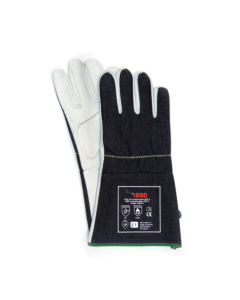

- Product Type configurable Remove This Item
- Flame Resistant Clothing Cal Rating 31.0 cal/cm2 Remove This Item